
There are some childhood interests that disappear almost as quickly as they arrive, yet slime seems remarkably determined to stay. Children still love stretching it, squashing it, mixing it and seeing what can be added to it next. For parents, the appeal can be slightly harder to understand, particularly when a homemade batch has previously found its way onto a sleeve, carpet or sofa (yep, speaking from expereince).
The So Slime Experience Lab Set takes that continuing fascination and turns it into a more structured creative activity. Rather than simply opening a pot of ready-made slime, children can choose a texture, follow the instructions and customise the result. It brings together sensory play, creativity and a little experimentation in a format that feels much more like an activity than another short-lived toy.
What is the So Slime Experience Lab?
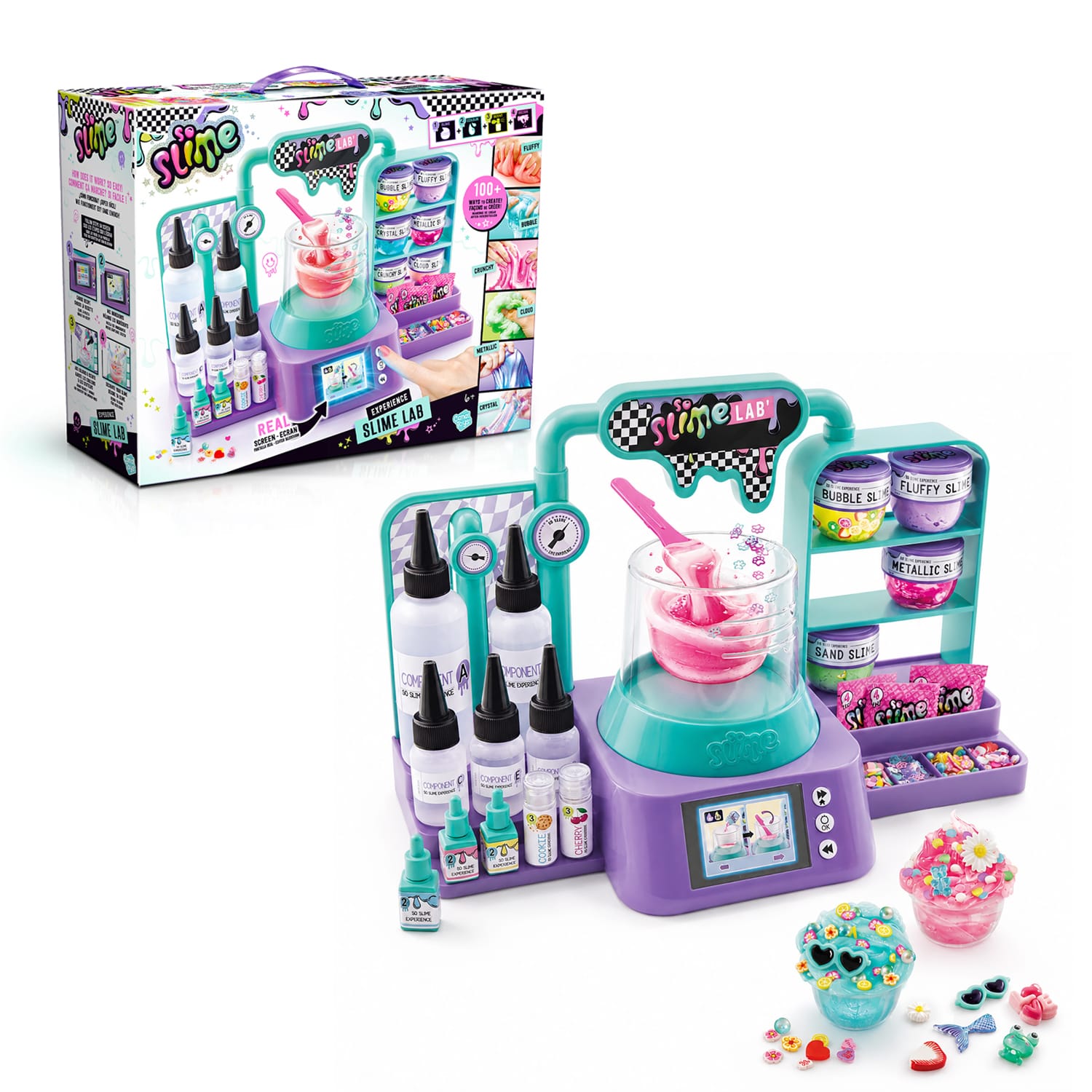
The So Slime Experience Lab is an electronic slime-making station designed for children aged six and over. Its digital screen guides children through the recipes step by step, showing them what to add and how to combine the ingredients. This gives them some independence without leaving them to guess their way through the process or requiring an adult to decipher complicated instructions throughout.
Children can make six different slime textures: fluffy, hydro, crystal, cloud, butter and crunchy. Once the basic texture has been created, they can experiment with colours, fragrances, decorations and charms. That ability to make choices matters, as it gives children a sense that the finished slime is genuinely their own creation rather than something they have simply assembled.
The set includes the Slime Lab, a mixing bowl, seven bottles, six slime pots, eight powder sachets, four mix sachets, eight charm packs, two ingredient pots, a spatula and a measuring cup. It requires three AA batteries, which are not included, so it is worth adding those if the set is being given as a birthday or Christmas present.
More than one way to make slime
One of the most interesting things about this kit is the range of textures. Many basic slime kits offer a choice of colour or glitter but produce essentially the same end result each time. Here, children can explore the difference between a soft cloud slime, a glossy or crystal-style slime and something with the extra texture of a crunchy slime.
That variety should help the activity last beyond the excitement of the first attempt. One child may want to follow each recipe carefully, while another may be far more interested in comparing textures or finding the most unusual combination of scent, colour and decoration. It also creates opportunities for siblings or friends to make different versions and compare what they have produced.
Why children get so much from sensory play
Slime is often dismissed as messy entertainment, although there is more happening during this kind of play than may be immediately obvious. Measuring, pouring, mixing and following a sequence all require concentration and coordination. Choosing ingredients encourages decision-making, while adapting a creation when it does not look exactly as expected helps children practise flexibility and problem-solving.
The finished slime also provides a very tactile form of play. Stretching, squeezing and folding it can be calming and absorbing for some children, particularly those who naturally seek out hands-on activities. Not every child enjoys sticky or unfamiliar textures, of course, and sensory play should never become something they are pushed to tolerate. The choice of six textures may make it easier for children to discover what they do and do not enjoy.
A creative activity that does not need to look perfect
Children are surrounded by craft videos in which everything appears polished, symmetrical and effortlessly successful. Real creativity rarely looks like that. Mixtures come out differently, colours are not always what was imagined and decorations sometimes end up everywhere except the intended place.
Slime-making gives children room to experiment without the pressure to create something recognisable or display-worthy. There is no correct way for a finished slime to look. The process is the point, and the squishing, stretching and redesigning can continue long after the initial recipe has been completed.
The digital guidance strikes a useful balance here. It provides enough structure to help the recipe work, while the personalisation still belongs to the child. Younger children may need help with measuring and reading the prompts, but an older child should be able to take more control once they understand how the lab works.
What parents will want to know before buying
This is still slime, so a little preparation will make the experience much easier. A wipe-clean table covering, old clothes and a clear working area are sensible. Long hair should be tied back, and slime is best kept well away from carpets, soft furnishings and any family pet likely to investigate it.
The kit contains small parts and is not suitable for children under three. Younger users should have adult supervision, particularly while ingredients are being measured and mixed. The slime is not edible, and children should wash their hands after use and keep it away from their eyes and mouth.
It is also worth considering where the finished creations will be stored. The six pots included in the set give each batch a home, which is preferable to discovering several unidentified sticky creations on bedroom shelves. As with most activity sets, the included ingredients will eventually run out. Refill kits are available, although this is an additional cost families may want to factor in if the lab becomes a firm favourite.
Is the So Slime Experience Lab a good gift?
At £29.99 at the time of writing, the So Slime Experience Lab sits above the price of a small craft kit but offers considerably more choice and repeat play. It is likely to work particularly well as a birthday or Christmas gift for a child who already enjoys slime, experiments, sensory play or making things from scratch.
It could also be a useful option for a playdate or a quieter afternoon at home, as creating several different textures gives the activity some natural structure. Parents will probably need to accept a certain amount of mess, but the guided process and dedicated mixing station make the whole experience feel more manageable than gathering random ingredients from around the kitchen.
Slime may never be the activity adults would choose for their own relaxing afternoon, but children return to it for a reason. It changes, responds and gives them something they can manipulate entirely on their own terms. The So Slime Experience Lab builds on that fascination by giving the process more variety and purpose, without taking away the wonderfully gloopy part children enjoy most.
