
Children love taking photographs, although handing over an adult’s phone is not always the most appealing way to encourage that interest. Aside from the risk of an accidental drop, a phone brings messages, apps and the wider online world into an activity that could otherwise be simple and creative.
The Photo Creator Beauty Cam Digital Camera offers children their own device for taking photographs, selfies and videos without needing access to a smartphone. Designed to look like a stylish pocket mirror, it combines a touchscreen camera with adjustable lighting, frames and filters. It is fun, portable and likely to appeal to children who enjoy creating content, although the emphasis on “beauty” deserves a little thought too.
What is the Photo Creator Beauty Cam?
The Photo Creator Beauty Cam is a compact digital camera aimed at children aged seven and over. It features front and rear lenses, allowing children to switch between ordinary photographs and selfies, as well as record videos. A touchscreen keeps the controls straightforward, while a built-in ring light offers white, natural and warm lighting modes.
There are 20 filters to experiment with, together with frames that can be added to photographs. The camera has internal memory, so children can begin using it immediately, and its storage can be expanded with a microSD card of up to 64GB. A rechargeable 600mAh battery is included, along with a USB charging cable and paracord wrist strap.
At £34.99 at the time of writing, it sits between a very basic toy camera and the more expensive children’s cameras with instant-printing functions. It does not print photographs, but that may suit families who would prefer not to keep buying paper refills.
A phone-free way to explore photography
One of the biggest advantages of a dedicated children’s camera is what it leaves out. Children can take photographs and make short videos without notifications appearing, messages being opened or social media becoming part of the experience. The focus stays on looking, noticing and creating.
That can change the sorts of photographs children take. Adults often reach for a camera when something feels important or visually impressive, while children are just as likely to photograph a favourite toy, the family pet, an interesting stone or the contents of a snack cupboard. Their photographs offer a glimpse of what catches their attention, rather than what an adult believes ought to be remembered.
A camera like this can also encourage children to think beyond selfies. They could photograph signs of autumn, create a visual diary of a day out, document a construction project or make a stop-motion-style sequence using toys. The video function lends itself to mini news reports, interviews, tutorials and invented adverts, giving the device more scope than its beauty-themed packaging might initially suggest.
The appeal of the pocket-mirror design
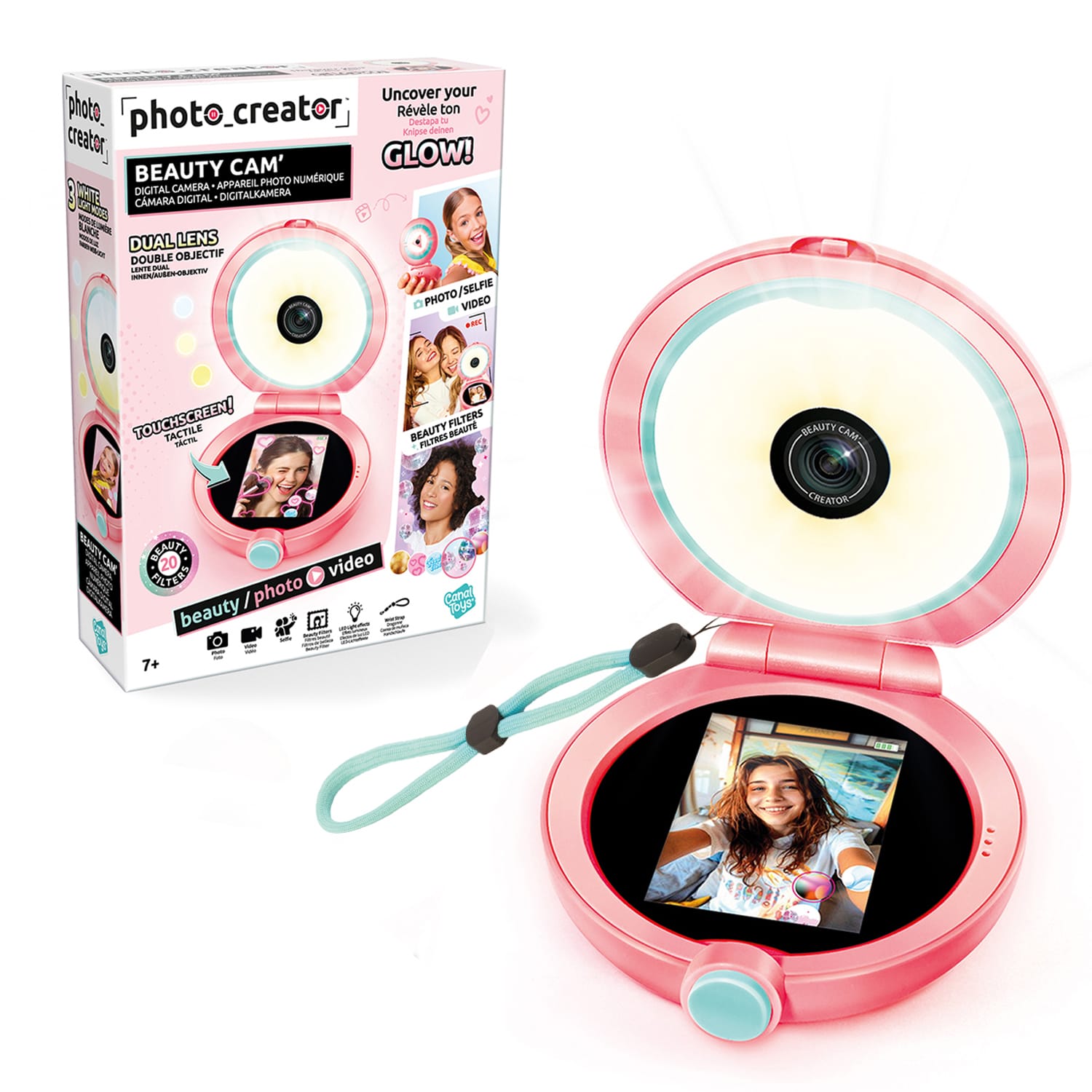
The Beauty Cam is clearly designed to feel more like an accessory than a traditional children’s camera. Its pocket-mirror shape, touchscreen and wrist strap make it easy to carry and help distinguish it from products aimed at much younger children. For tweens who have outgrown brightly coloured, chunky cameras but are not ready for their own phone, that styling may be a significant part of the appeal.
The three light settings also give children a practical introduction to the way lighting changes a photograph. Experimenting with warm, natural and white light can lead to conversations about shadows, colour and why the same subject can look different depending on where and how an image is taken. Those are genuine creative skills, even when children believe they are simply trying to capture the best selfie.
What about the beauty filters?
The phrase “beauty filters” on a product for children may make some parents pause, and reasonably so. Filters can be playful, particularly when they change colours or add decorative effects, but they also sit within a much wider culture that routinely presents altered faces as ordinary. Children can absorb the idea that photographs need to be improved before they are worth sharing.
Avoiding every filtered image is probably unrealistic. A more useful response may be to help children understand what filters do and why they are used. Comparing the same photograph with and without an effect can make editing visible rather than mysterious. Parents can talk about how lighting, angles and software change an image, and remind children that an edited photograph is a creative version of a moment, not a standard their real face is expected to meet.
The camera, therefore, has the potential to support some early media literacy, provided adults are willing to have the conversation. The aim does not need to be banning filters or turning photography into a lesson. It is simply helping children enjoy them without confusing a digital effect with a requirement to look different.
Creativity, privacy and sharing
A dedicated camera keeps children away from social media while they are taking photographs, but parents still need to think about what happens to the images afterwards. Transferring files to another device can be a good opportunity to look through them together and discuss which photographs are private, which include other people and which would be appropriate to share.
Children should learn that taking someone’s photograph does not automatically give them permission to post or send it. Bedrooms, school uniforms, house numbers and location clues can reveal more than they realise. These conversations are easier to begin while photography is still playful and contained than after a child has unrestricted access to multiple sharing platforms.
The expandable storage is useful for holidays and busy days out, although families may want to regularly move favourite images to a computer and clear the rest. Children can take an extraordinary number of near-identical photographs when storage feels unlimited.
Is the Photo Creator Beauty Cam worth considering?
The Photo Creator Beauty Cam is likely to suit a child who enjoys taking selfies, making videos, dressing up or creating their own mini productions. It is portable, rechargeable and simple enough to use independently, while the front and rear cameras give it more flexibility than a basic toy camera.
Its “beauty” branding will not appeal to every family, and the filters should not be treated as entirely neutral. However, the camera can be used for far more than changing how a face looks. In the right hands, it becomes a tool for noticing details, telling stories and recording family life from a child’s point of view.
Perhaps the most valuable feature is not the ring light or touchscreen at all. It is the chance for children to explore photography on a device that belongs to them, without also handing them everything that comes with a smartphone.

2 comments
The distinction between playful effects and teaching children that every face needs correction is important. I work on RestorePhoto, and our rule for family images is to keep the untouched original, label edited versions clearly, and check that eyes, mouth, skin texture, and face shape have not drifted. Filters can be fun, but children should still be able to recognise the unedited photograph as the source record.
Hi,
I think apps like Photo Creator Beauty Cam can be fun for experimenting with photos, especially for people who enjoy trying different creative effects and editing styles. It’s worth keeping a balance, though, so filters enhance creativity rather than changing how we see ourselves. I recently came across https://inshotproapk.net/ as another option for mobile photo and video editing.