
Preparing Children for the Future Is No Longer About Following One Path
For generations, the idea of preparing children for adult life seemed fairly straightforward. Do well at school, pass exams, gain qualifications, find a stable career and build a secure future. That path made sense in a world where industries changed more slowly, jobs were more predictable and success often followed a familiar structure.
That is no longer the reality many children are growing up in.
Today’s young people are entering a world shaped by rapid technological change, artificial intelligence, automation, global competition and shifting social expectations. Entire industries are evolving at speed. Some jobs are disappearing, others are transforming, and many future careers do not yet fully exist. In that context, preparing children for the future cannot simply mean helping them collect grades and follow a narrow definition of achievement.
The bigger question now is whether children are being equipped with the skills, mindset and resilience needed for a world that is changing faster than traditional systems can keep up.
Why Traditional Definitions of Success Are Being Challenged
Many school systems were built around the needs of an earlier economic model. They were designed to produce reliable workers who could follow routines, absorb information and fit into structured roles. That legacy remains visible in many aspects of education today, from standardised testing and rigid timetables to a heavy focus on measurable outcomes.
There is still value in structure, academic rigour and strong subject knowledge. Children need literacy, numeracy, scientific understanding and the ability to communicate clearly. Those foundations matter. The problem is that those foundations are often treated as the whole picture.
A child can achieve high marks and still feel unprepared for uncertainty, change, problem-solving or independent decision-making. Another child may appear to struggle in a traditional setting while showing remarkable strengths in creativity, leadership, design, innovation or practical thinking.
Preparing children for the future means looking beyond one narrow model of success and recognising that intelligence, capability and potential can show up in many different forms.
The World Children Are Entering Looks Very Different
The future of work is one of the biggest reasons this conversation matters so much. Children growing up now are likely to experience several careers across their lifetime rather than one single professional path. Some will work in roles that blend technology with creativity. Others may build their own businesses, work freelance, create portfolio careers or shift repeatedly as industries evolve.
Artificial intelligence is already changing the way people write, research, design, code and communicate. Automation continues to reshape manual, administrative and repetitive roles. Digital tools are making information more accessible than ever, which means memorising facts alone is no longer enough.
In that environment, the most valuable human qualities may be the ones that are hardest to automate. These include judgement, empathy, collaboration, curiosity, flexibility, initiative and original thought.
That shift should matter deeply to parents, educators and anyone thinking seriously about preparing children for the future.
The Skills That Matter Most in a Changing World
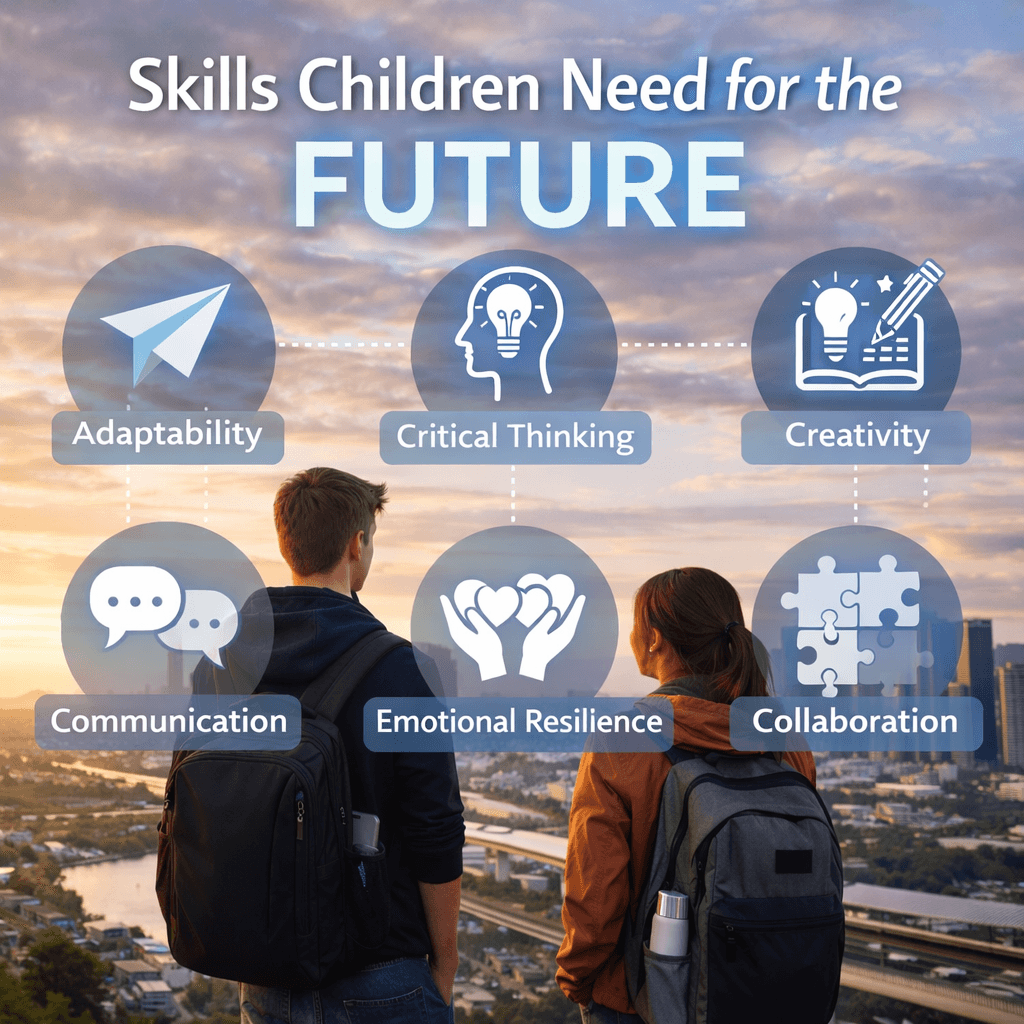
Preparing children for the future involves more than academic performance. It includes helping them develop broader life and learning skills that can travel across different situations, industries and challenges.
Adaptability
Children will need to cope with change rather than fear it. Adaptability helps them adjust when plans shift, technology changes or circumstances become uncertain. This is one of the most important long-term skills in a world where stability can no longer be assumed.
Critical thinking
Children are growing up surrounded by information, opinion and digital influence. They need to be able to question what they see, assess credibility, weigh evidence and think independently. Critical thinking protects them from passive consumption and helps them become active decision-makers.
Creativity
Creativity is often misunderstood as something reserved for artistic children. In reality, it is central to problem-solving, entrepreneurship, innovation and leadership. Creative children are often the ones who see possibilities others miss.
Communication
The ability to express ideas clearly, listen well and engage with others respectfully remains fundamental. Strong communication supports relationships, teamwork, confidence and employability across every field.
Emotional resilience
Life will not become easier simply because technology becomes more advanced. Children still need to manage setbacks, uncertainty, disappointment and pressure. Emotional resilience helps them recover, adapt and keep moving forward when things do not go to plan.
Collaboration
Modern life increasingly requires people to work with others across cultures, disciplines and perspectives. Learning how to cooperate, contribute and navigate differences is essential.
Why Some Children Feel Left Behind by Traditional Systems
Not all children are well served by environments that prioritise compliance, repetition and exam performance above all else. Some children learn best through doing, building, moving, discussing or experimenting. Others are highly capable but disengage when education feels disconnected from real life. This can create a damaging mismatch.
Children whose strengths do not align neatly with traditional measures may begin to see themselves as less able, less intelligent or less successful. That perception can affect confidence, motivation and long-term self-belief.
In many cases, the issue is not that the child lacks potential. The issue is that the system is not recognising the form that potential takes.
Preparing children for the future requires a broader view of what learning looks like and what progress really means. It requires adults to notice strengths that may not appear on a test paper.
What Parents Can Do at Home
Families cannot single-handedly redesign education systems, yet they can do a great deal to support future-ready development at home.
One of the most valuable things parents can do is to create space for curiosity. Children benefit from asking questions, trying things out, making mistakes and exploring interests without every activity being judged by performance alone.
Real-world experiences can be especially powerful. Cooking teaches planning, sequencing and independence. Building projects develop problem-solving and persistence. Sport can strengthen discipline, teamwork and resilience. Creative hobbies encourage experimentation and self-expression. Discussions about current events, money, ethics, business ideas or technology can help children think more deeply about the world around them.
Preparing children for the future also means allowing them to wrestle with challenges rather than rescuing them too quickly. Frustration, setbacks and trial-and-error are all part of meaningful growth.
Children do not need perfectly managed lives. They need opportunities to think, adapt and recover.
Education Needs a Wider Lens
This is not an argument against academic learning. Knowledge still matters. Reading, writing, maths, science and subject expertise remain important building blocks for later life. The issue is balance.
A truly future-focused approach to education would value knowledge alongside initiative, creativity alongside rigour, and emotional development alongside measurable attainment. It would recognise that children need both foundations and flexibility. It would prepare them not just to pass exams but also to navigate uncertainty, contribute meaningfully and build lives of purpose in a changing world.
Preparing children for the future should not mean pressuring them to become perfect, endlessly productive or prematurely career-focused. It should mean helping them develop the confidence and capacity to meet the unknown with curiosity and strength.
A Better Question for Parents and Educators
Perhaps the most important shift is this: instead of asking only, “How can children succeed at school?” it may be time to ask, “How can children thrive in life beyond school?” That question opens up a much richer conversation.
It invites a broader understanding of learning, talent and success. It encourages adults to notice the qualities that matter in real life, not just in formal assessment. It makes room for children who think differently, move differently, create differently and learn differently.
Preparing children for the future has become one of the defining responsibilities of modern parenting and education. The future will not belong only to those who can memorise the most or perform well under narrow conditions. It is likely to reward those who can think, adapt, collaborate, communicate and keep learning as the world changes around them.
That is the challenge. It is also the opportunity.
