
I have not particularly liked storms since my family were involved in a tornado in France when I was ten. In addition to that, flying, and in particular, flying in bad weather, has been hard for me since my early twenties. I have always made the obvious connection between the two, although I have never found it especially helpful when people try to reassure me with statistics about aviation safety or explanations of how thunderstorms develop. I understand that planes are built to withstand challenging conditions and that storms are a natural part of our weather systems. Knowing these things, however, has never been quite the same as feeling comfortable with them.
When the opportunity arose to have some sessions with Christopher Paul Jones, a therapist who specialises in fears, phobias and anxiety, I was interested to see whether his approach might make a difference. I was also curious about the process itself. Fear is something most of us experience in one form or another, yet we rarely spend much time examining why certain situations affect us so strongly when others barely register. I remember as a child and teenager often feeling quite fearful of heights, yet as an adult, this has bothered me less. On the other hand, there are things I am afraid of as a parent that never bothered me as a child, so these things also alter over time.
What I had not anticipated about these sessions was how far our conversations would move beyond the two concerns I had originally wanted to address. Although storms and flying in bad weather provided the starting point, the sessions prompted me to consider experiences, memories and beliefs that I had never previously connected. I came away with a different understanding of how my mind interprets events, alongside a noticeable change in the feelings that had brought me to Christopher in the first place.
Disclosure: I received four complimentary therapy sessions with Christopher Paul Jones. The views and experiences shared in this article are entirely my own.
When knowing the facts makes little difference
There is a particular kind of frustration that comes with being anxious about something you already understand reasonably well. You can explain the situation to yourself, consider the likelihood of different outcomes and recognise that your reaction is stronger than the circumstances might justify, yet the feeling persists. Sometimes that awareness adds another layer of irritation, as you find yourself questioning why you cannot simply respond in the way you would prefer.
Flying is a good example. Most nervous passengers are already aware that commercial flying is extremely safe, and they have probably heard countless explanations about turbulence. Some may even be able to discuss the subject quite confidently when they are sitting comfortably at home. The difficulty arises when the prospect of encountering turbulence becomes personal, particularly if there is a forecast suggesting unsettled weather around the time of a journey.
Storms can create a similar problem. Understanding what causes thunder and lightning does not necessarily change the emotional response to an approaching storm, especially when there is an element of unpredictability involved. The anticipation can become part of the experience, sometimes occupying far more time and attention than the weather event itself.
I think this is one of the reasons I was interested in working with Christopher. I wasn’t looking for someone to provide more reassurance about the things I already knew. I wanted to explore why my response was it was the way it was, and whether there was a way to feel differently without needing the circumstances themselves to change. I don’t want my fears to limit me or my family in any way.
Four sessions that went somewhere unexpected
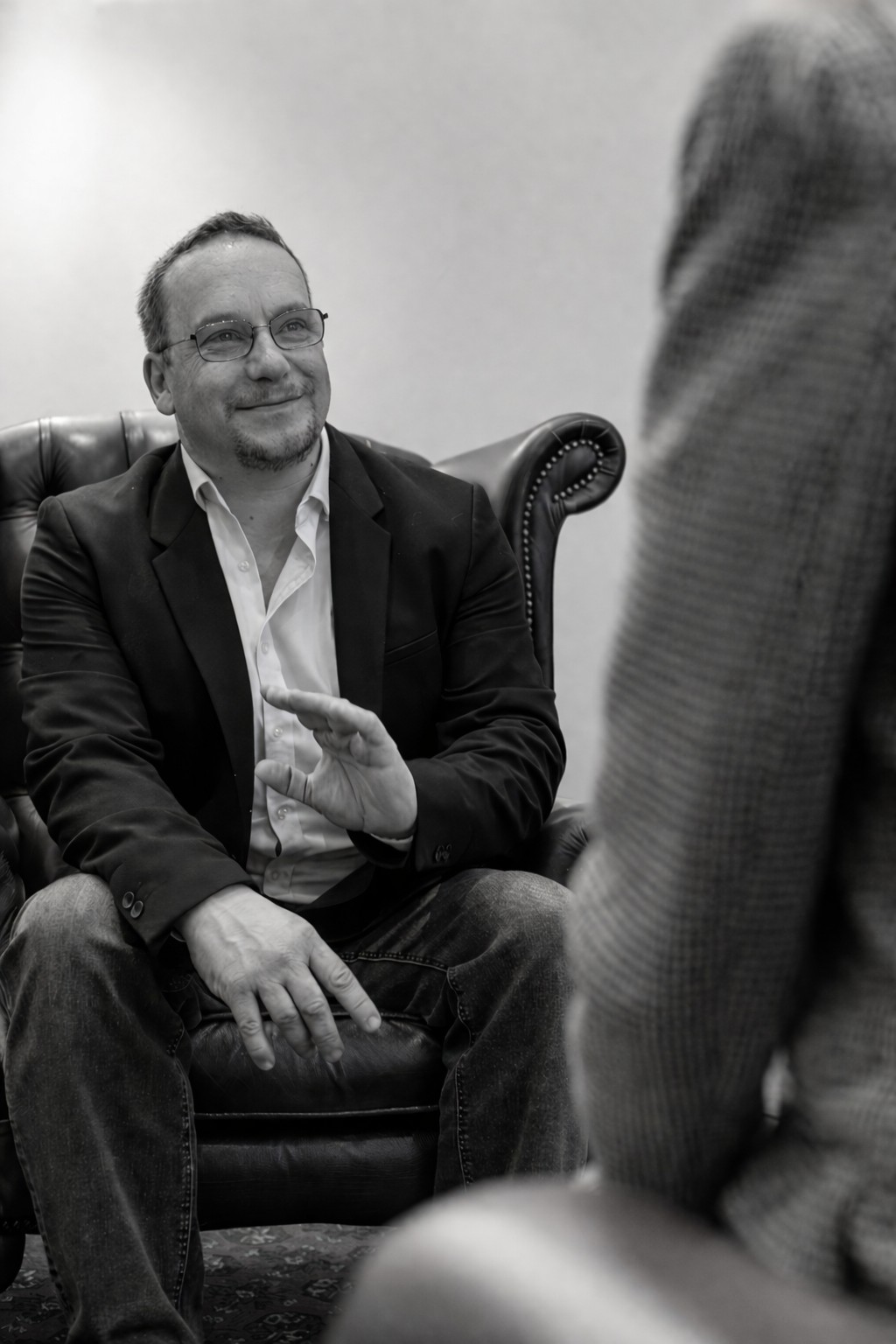
Christopher’s approach involves looking at the individual experience of fear rather than concentrating exclusively on the situation that appears to trigger it. He draws on different therapeutic techniques and encourages clients to examine the thoughts, feelings and associations surrounding their concerns.
During our four sessions, I found myself considering connections between experiences and beliefs that had not previously occurred to me. I had approached the process thinking primarily about storms and flying, yet our conversations became much broader. Some of the connections we explored were surprising, particularly because they involved things I had always considered separately.
It made me realise how rarely we examine the assumptions we have developed about ourselves. We tend to describe certain reactions as part of our personality, particularly when they have been present for a long time. Someone might say they have always been nervous about flying, that they simply cannot cope with spiders or that they have never been comfortable speaking in front of other people. After a while, these descriptions can become so familiar that we stop questioning them. Does that sound familiar?
I had certainly not spent much time considering whether my own responses were connected to other experiences and beliefs. I knew how I felt about storms and flying in bad weather, but I had not really examined the wider context of those feelings. Working with Christopher gave me the opportunity to do that, and I found the process both fascinating and incredibly helpful.
What struck me most was that understanding an emotional response can involve much more than identifying the obvious situation associated with it. We bring our previous experiences into the present in ways we do not always recognise, and the meanings we attach to events can influence how we anticipate similar situations in the future.
I would not suggest that every fear has a hidden explanation waiting to be uncovered, or that memories provide a simple answer to complicated emotional difficulties. What I can say is that exploring the connections between my own experiences and beliefs was unexpectedly valuable. It helped me make sense of things I had not previously considered together, which was interesting in itself, quite apart from any change in how I felt afterwards.
The difference between being anxious and being irritated
The most significant change I have noticed since the sessions is also one of the simplest to describe. Where storms and the prospect of flying in bad weather previously made me feel very anxious, I now find that my response is much closer to irritation. Whilst I haven’t been on a plane yet since the sessions, we had a severe storm last week, so that provided a partial ‘test’ for me.
It is an interesting distinction, particularly because irritation is not usually something we celebrate. Most people would probably prefer to feel completely relaxed about situations they cannot control rather than finding them annoying. In this case, however, irritation represents a considerable improvement.
Storms have not become something I particularly look forward to. The difference is that my feelings about these situations seem to have shifted away from the anxiety I previously experienced and towards the sort of annoyance I might feel about any other inconvenient aspect of life, and that is a vast improvement in a very short space of time.
The change has been in my response, not the situation, which has made me appreciate how much of our experience of a situation depends on the feelings we associate with it.
There is also something quite liberating about realising that progress does not have to mean becoming completely fearless. I had not really considered irritation as a possible outcome when I first began working with Christopher, yet it now seems like a perfectly reasonable place to have ended our sessions. I don’t need to be enthusiastic about every aspect of flying or indifferent to severe weather. Feeling considerably less anxious is more than enough to make the experience worthwhile.
Who is Christopher Paul Jones?

Christopher Paul Jones specialises in helping people address fears, phobias and anxiety. His interest in this area developed partly from his own experiences of living with phobias, which led him to explore different therapeutic approaches before developing a method he calls the Integrated Change System.
His work brings together techniques associated with several disciplines, including cognitive behavioural therapy, clinical hypnotherapy, psychotherapy, mindfulness and neuro-linguistic programming. The idea behind this combined approach is that people experience fears differently, so the way they work through them may also need to vary.
One of the aspects of Christopher’s work that interested me was his emphasis on the possibility of making progress without necessarily committing to years of therapy. He reports that some clients experience significant improvements within a relatively small number of sessions – 1-4 is the average number of sessions required.
There are established psychological treatments for specific phobias, particularly cognitive behavioural approaches involving exposure, and these can also be delivered over relatively short periods in some circumstances. The most appropriate support depends on the individual and the nature of their difficulties, so it is important not to assume that one approach or timeframe will suit everyone.
My own experience consisted of four sessions, and I noticed a meaningful difference in how I felt afterwards. I would not want to make promises about what anyone else might experience, but I do think there is value in knowing that longstanding fears are not necessarily beyond change.
Why this experience has made me think about parenting
One of the things that has stayed with me is how often we try to reassure children about their fears without really understanding what those fears feel like to them. As parents, we naturally want to make difficult situations easier, particularly when we can see that a child is becoming anxious about something that appears relatively harmless.
We might explain why a dog is friendly, reassure a child that they will be fine at a new activity or remind a teenager that giving a presentation is unlikely to be as terrible as they imagine. These responses come from a good place, and reassurance can be important, but it does not always change the feeling itself.
My sessions with Christopher have made me more interested in the connections between experiences, beliefs and emotional responses, particularly when someone is struggling to explain why they feel a certain way. It is easy to assume that another person should respond to a situation as we do, when their experiences and expectations may be completely different.
This suggests that there is value in being curious about what a child is experiencing rather than concentrating exclusively on persuading them that there is nothing to worry about.
I also think it is useful for parents to recognise that our own emotional responses can change. We are often so busy helping everyone else manage their feelings that we give relatively little attention to difficulties we have quietly accepted as part of our lives. Sometimes those difficulties have been present for so long that we no longer consider doing anything about them.
Exploring Christopher’s approach for yourself
For anyone curious about Christopher’s work, he has written a book called Face Your Fears: 7 Steps to Conquering Phobias and Anxiety, published by Michael O’Mara Books. It introduces his approach and includes exercises readers can explore themselves, making it a useful starting point for people who would like to understand more about his methods before considering individual sessions.
I would encourage anyone interested in the subject to read the book rather than rely on a brief explanation of its contents. Part of the value of exploring a subject like this is having the opportunity to consider the ideas in relation to your own experiences, and a short article cannot provide the same depth or practical detail.
The book is not a replacement for professional assessment or treatment where that is needed, but it offers a way to become familiar with Christopher’s thinking and decide whether his approach is something you would like to investigate further.
What I have taken away from the experience
Looking back, the four sessions were valuable in ways I had not anticipated when I first arranged them. I expected to concentrate on storms and flying in bad weather, but the conversations helped me make connections between experiences and beliefs that I had never previously considered. I found that process interesting, particularly because it changed the way I think about how my brain remembers and interprets events.
The improvement in how I feel has been equally significant. I am not claiming that I have become completely indifferent to storms or turbulence, and I do not think that should necessarily be the measure of success. What matters to me is that situations which previously generated considerable anxiety now seem to provoke irritation instead.
That might sound like a small distinction to someone who has never experienced a similar fear, but it feels like a substantial change when you have lived with the stronger emotional response. I also appreciate that the process gave me a better understanding of myself, rather than simply leaving me with a different feeling about two particular situations.
Perhaps the most useful thing I have taken from the experience is the recognition that we do not always understand our own reactions as well as we imagine. There can be connections between experiences and beliefs that we have never consciously considered, and exploring them may change the way we interpret situations that have troubled us for years. Prior to working with Christopher I would have said I was fairly self-aware, refelctive and had a decent handle on why I felt a certain way about things, but now I feel like I understand myself much better and have made new links and gained new understanding.
You can find out more about Christopher’s work at christopherpauljones.com and follow him over on Facebook
This article reflects my personal experience of four complimentary sessions with Christopher Paul Jones. Individual experiences and outcomes vary, and people experiencing persistent or severe anxiety should seek advice from an appropriately qualified healthcare professional.
