
Few phrases create more confusion and frustration in creator negotiations than “great exposure”. It often appears in emails framed as opportunity:
- “We don’t have a budget for this one.”
- “This would be editorial.”
- “It’s a gifted collaboration.”
- “It’s unpaid, but it’s excellent exposure.”
When brands offer ‘exposure’ instead of payment, the language is deliberate. It softens the request. It implies strategic benefit. It suggests long-term value rather than immediate compensation.
The difficulty is not simply deciding whether to accept unpaid brand collaboration requests. The difficulty is understanding what is actually being offered.
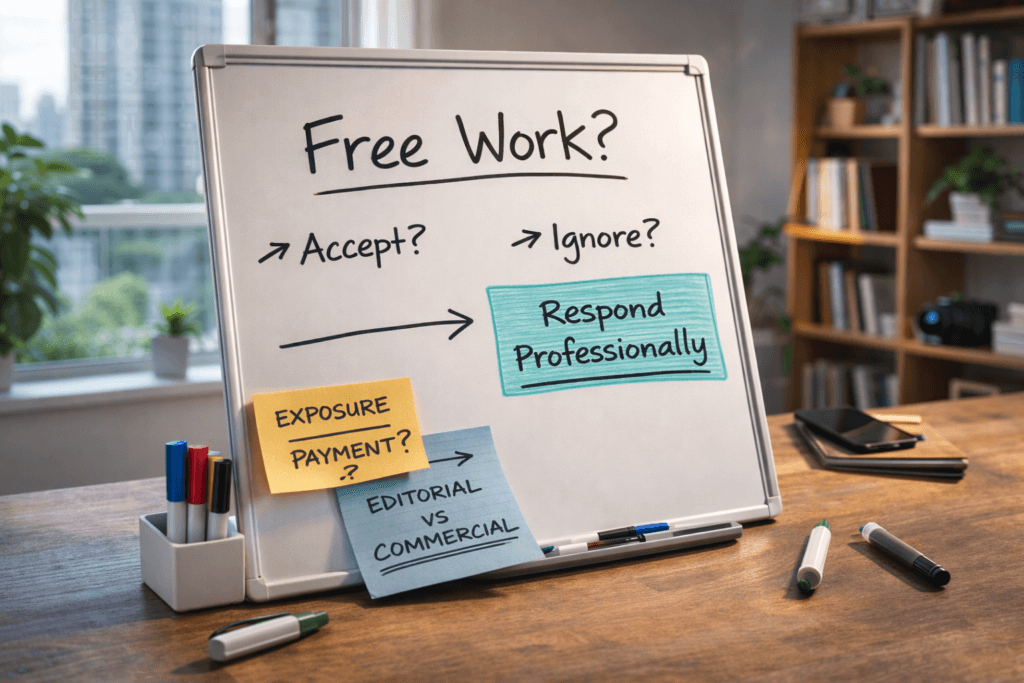
The Commercial Difference Between Editorial and Sponsored Work
In traditional media, editorial coverage and paid advertising are clearly separated. Editorial exists independently of payment. Sponsored content exists within defined commercial agreements. Within the creator economy, those boundaries are often blurred.
When a brand approaches a creator directly and requests specific deliverables – a blog article, an Instagram post, a video or story sequence – the request is commercial in nature. The brand is seeking:
- Distribution
- Audience access
- Content production
- Brand alignment
Reframing that request as “editorial” does not alter its commercial function. If the brand is defining the output and messaging, the collaboration is not neutral editorial coverage. It is sponsored work without a fee. Understanding this distinction is critical when evaluating unpaid brand collaboration offers.
Why Exposure Is Framed as Compensation
Exposure is often positioned as currency. The suggestion is that visibility today may translate into future opportunity.
In some contexts, particularly for early-stage creators building portfolios, unpaid collaborations may serve strategic purposes. However, exposure is speculative. It does not guarantee return.
Paid collaborations, by contrast, represent structured exchanges. They acknowledge time, production effort, audience reach and usage rights.
When exposure replaces payment in a clearly commercial arrangement, the exchange becomes asymmetrical. The creator absorbs risk. The brand receives defined output. That imbalance is rarely stated explicitly.
The Structural Challenge Creators Face
Many creators recognise when an offer feels misaligned. What they often lack is structured language to decline unpaid work professionally.
Without preparation, responses typically fall into one of three patterns:
- Accepting reluctantly
- Responding emotionally
- Avoiding the email
None of these approaches protects long-term positioning. Declining unpaid work does not need to be confrontational. It requires clarity.
How to Respond to Free Work for Exposure Offers
A professional response does not attack the brand. It clarifies commercial boundaries. For example, a structured reply might explain that while editorial features are always appreciated, commissioned content and defined deliverables fall within paid partnership agreements. It may then outline alternative options, such as:
- A reduced-scope paid collaboration
- A smaller content package
- A delayed collaboration when budget becomes available
This approach maintains respect while reinforcing pricing integrity. The goal is not to criticise the request. It is to distinguish between unpaid editorial goodwill and commercial distribution.
The Long-Term Impact of Accepting Unpaid Brand Collaboration
Repeated acceptance of unpaid commercial work establishes precedent. PR agencies track flexibility. Brands note responsiveness. Over time, positioning becomes difficult to reset.
Conversely, consistent and professional pushback signals that your work operates within commercial parameters. That consistency does not eliminate unpaid offers. It changes how they are handled.
Where Structured Support Reduces Friction
Conceptually, understanding exposure framing is straightforward. In practice, responding calmly in the moment can feel difficult. Many creators draft replies under pressure. Language softens. Boundaries blur.
Structured systems like Creator Capital exist to formalise negotiation responses for common scenarios, including gifted collaboration negotiation, unpaid brand collaboration requests and exposure-based proposals.
The emphasis is not on confrontation. It is on procedural clarity. By distinguishing between editorial coverage and commercial deliverables in prepared language, creators can decline unpaid work professionally without damaging relationships.
When that structure is in place, exposure-based offers become easier to evaluate objectively. Negotiation becomes predictable rather than emotional.
